

Last Updated on: 17th February 2025, 07:46 pm
This travel itinerary visits Russia’s two main cities: Moscow and St Petersburg.
Day1: St Petersburg
St Petersburg is an elegantly attractive city built on the Neva River. There are other small rivers as well as canals which add to the appeal.
Evening:
We attended an opera performance at the Mariinsky II. It is the modern sibling of the ornate original Mariinsky Theatre which opened in 1860 and is home to one of the world’s leading ballet companies, the Mariinsky (Kirov) Ballet.

On the way back to our hotel we stopped on a bridge over the Neva River to view the night lights.
Overnight:
St Petersburg
Day 2: St Petersburg
Morning and Afternoon:
Peter and Paul Fortress
The Peter and Paul Fortress is located on a small island on the north bank of the Neva River. Peter the Great built fortifications here in 1703 and this is considered to mark the founding of St Petersburg.
From early on the fortress also served as a prison for high-ranking or political prisoners. The Trubetskoy Bastion was opened as a prison block in 1872 and is now an interesting museum.
The Saints Peter and Paul Cathedral is the burial place of almost all Russian tsars from Peter I to Alexander III. The remains of the last tsar, Nicholas II, and his family were re-interred here, 80 years after their execution.
The Museum of Cosmonautics and Rocket Technology did not live up to our expectations.
A cannon is fired at noon every day from the Naryshkin Bastion.
Church of the Saviour on Spilled Blood

The Romanov imperial family erected this church on the site where Tsar Alexander II was assassinated in 1881. It was built between 1883 and 1907, but in the traditional Russian style. In subsequent years, the church was looted, damaged and generally neglected. After a major restoration, it was reopened in 1997. The interior walls and ceilings are completely covered in the most beautiful mosaic artwork.
St Isaac’s Cathedral

Tsar Alexander I commissioned a church to be built that would be an impressive landmark of the Russian imperial capital. St Isaac’s lives up to its brief. It was built between 1818 and 1858 and has a neoclassical design. There were several engineering challenges, the first of which was the requirement for thousands of piles to be driven into the ground to provide a stable foundation. Don’t miss the huge red granite columns outside with each hewn and erected as a single block.
In 1931 (Soviet era), it was turned into the Museum of the History of Religion and Atheism!
Palace Square
The oldest building on the square, on the south embankment of the Neva River, is the Winter Palace (1762). The gracefully curved General Staff Building was built on the southern side of the square (1829). On the eastern side is the Guards Corps Headquarters (1843). Even though the buildings were built at different times and are different styles (baroque and neoclassical), they form a harmonious whole.

In the centre of this vast square is the red granite Alexander Column.
Palace Square has been the scene of important historical events. In 1905 it was the site of the Bloody Sunday Massacre. In October 1917, in an act against the Provisional Government, Bolshevik-led revolutionary forces stormed and sacked the Winter Palace.
Overnight:
St Petersburg
Day 3: St Petersburg
Peterhof
Peterhof is situated south west of the historical centre of St Petersburg, on the southern shore of the Gulf of Finland.

The opulent Grand Peterhof Palace with the Grand Cascade, Lower Park and Upper Garden are the main attractions. Peter the Great was responsible for the original design concept and the official opening took place in 1723. Tsarina Elizabeth, who came to the throne in 1740, was responsible for major extensions to the Grand Palace.
From spring onwards, you can take a boat from central St Petersburg to Peterhof. We took the metro to the beautiful Avtovo Station. (As with the Moscow metro / underground / subway, the St Petersburg underground has several decorated metro stations). From there you can take a small municipal bus or shuttle to Peterhof. It took us about 1.25 hours in total to get there.
Another magnificent palace that is a top attraction in St Petersburg is the Catherine Palace at Tsarskoe Selo.
Afternoon:
The State Hermitage Museum
This afternoon we headed back to Palace Square to visit the renowned Hermitage Museum.
If you use Admiralteyskya metro station to get to Palace Square, you will notice that the escalator ride up is very long: this subway station is one of the deepest in the world at 86 m (282 ft) below ground.
The best-known components of the Hermitage Museum are the Winter Palace, the Small Hermitage and the Large (Old) Hermitage, which are all connected.
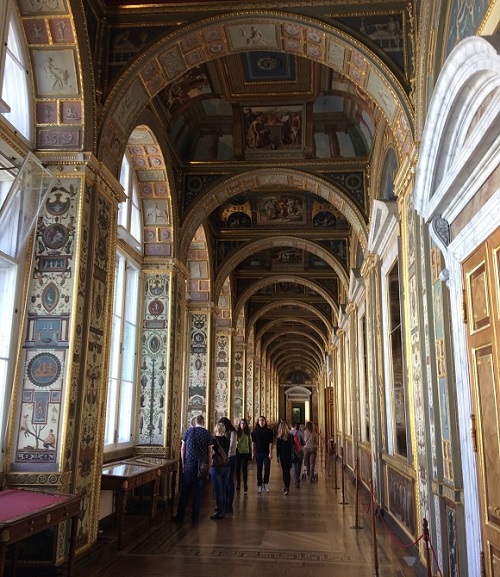
It was Catherine the Great who added the Small Hermitage (originally intended as a more private palace) to the Winter Palace. As her extravagant acquisition of art collections grew, she needed to add the Large Hermitage to house the art.
Overnight:
St Petersburg
Day 4: Moscow
Morning and afternoon:
We took the Sapsan high-speed train to Moscow. The train left and arrived on time and took just less than 4 hours to cover the 650 km. It was a most convenient and pleasant journey, with the obvious benefit of being able to see the scenery en route.
Evening:

We went to see Red Square by night; ironically, the square has a fairy-tale quality when lit up. Depending on the time of year, it may be quite late before it is fully dark.
Overnight:
Moscow
Day 5: Moscow
Morning:
Red Square
St Basil’s Cathedral

This amazing iconic church was commissioned by Ivan the Terrible to commemorate his victory over Kazan. It was completed in 1561, though some changes were made in following centuries. The church consists of nine chapels of which the largest is the central Chapel of the Intercession.
GUM
GUM shopping centre was originally the Upper Trading Rows completed in 1893 on a traditional market site. It has a Russian-revival style façade and attractive interior. Many shops sell high-end international brands.
Other attractions on Red Square are Lenin’s Mausoleum, Kazan Cathedral and the State Historical Museum.
Tomb of the Unknown Soldier

The Tomb of the Unknown Soldier is a memorial dedicated to the Soviet soldiers killed during World War II. It is located next to the Kremlin Wall near the Corner Arsenalnaya Tower. The Changing of the Guard ceremony takes place on the hour.
Afternoon:
The Kremlin
The Kremlin has been synonymous with power for centuries. The Moscow Kremlin is the oldest part of the city and is therefore its historical centre. A wooden fortification was built on the site in 1156.
Make sure that you are standing in the correct queue at the Kremlin ticket office as some queues are longer than others.
Grand Kremlin Palace
The Grand Kremlin Palace used to be an imperial palace. Tsar Alexander I commissioned the construction which was completed in 1849 but incorporates an older palace, hall and churches. It is currently the official residence of the president of Russia and the venue for official receptions and ceremonies. Access is only by special arrangement.
Armoury Chamber and the Diamond Fund Museum
The Armoury Chamber is the Russian treasury museum with the crown jewels in the Russian Diamond Fund Museum.
Cathedral Square

Cathedral of the Assumption / Dormition Cathedral
It is thought that churches existed on this site since the 12th century. The current building was completed in 1479. It was the most important church in Moscow and was the site of coronations of the tsars and appointments of metropolitans and patriarchs of the Orthodox Church as well as the burial place of these leaders.
Cathedral of the Archangel

The Cathedral of the Archangel in the Kremlin was built in 1508. It was the main burial place of Moscow’s grand princes and tsars until Peter the Great moved the capital to St Petersburg. The Cathedral’s murals were painted in the 17th century by artists from the Kremlin’s Armoury Chamber.
Cathedral of the Annunciation
This cathedral was the home church for Russian tsars and their families. It was the site of royal marriages and baptisms and where they went to confession. The present-day Cathedral was built after a fire destroyed the original building in 1547.
Other top attractions of Cathedral Square are the Church of the Deposition of the Robe, Ivan the Great Bell Tower and the Patriarch’s Palace with its Church of the Twelve Apostles.
Overnight:
Moscow
Day 6: Moscow
Morning and afternoon:
The Moscow Metro

The Moscow underground stations built in the Stalinist era are attractions in their own right. This is because Stalin declared that they should be the “palaces of the people.” The stations have different styles and themes, so it is worth planning a route to see a good selection. Note that not all current-day stations are decorated, many are just functional.
River cruise

We took a boat trip down the Moskva River and back. This provides a relaxed way to see Moscow from a different perspective.
Overnight:
Moscow