

Last Updated on: 17th February 2025, 07:53 pm
Cape Town is undoubtedly one of the world’s most beautiful cities, with its layout defined by the mountains and the sea.
Cape Town is the site of the earliest European settlement in South Africa and is therefore sometimes referred to as the Mother City: the Dutch East India Company established a refreshment station here for its ships in 1652.
Contrary to the rest of South Africa, Cape Town and surrounding areas have a Mediterranean climate (warm to hot, dry summers and mild, wet winters).
If you are visiting, there is enough to keep you busy for days. Please see below my selection of Cape Town’s top sightseeing attractions.
Victoria and Alfred (V&A) Waterfront
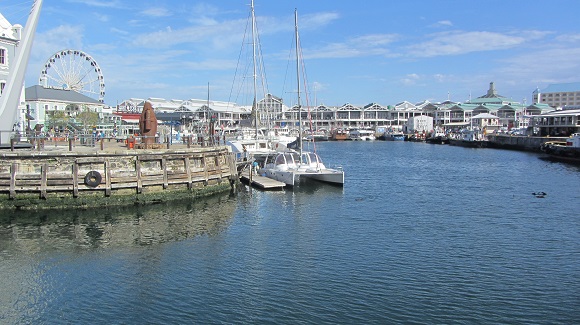
I have listed the V&A Waterfront first as it is a good location reference point and most tourists to Cape Town will visit here.
The V&A Waterfront is a sprawling development at the original Cape Town Harbour (the Victoria and Alfred Basins) in Table Bay. It is home to shops, restaurants, eateries, bars, hotels, heritage buildings and museums.
Well known attractions at the V&A Waterfront are the Two Oceans Aquarium, Zeitz Museum of Contemporary Art Africa (MOCAA) and the Cape Wheel.
Keep a lookout for seals playing in the water or relaxing at the “seal landing” near the Clocktower Bridge.
Table Mountain
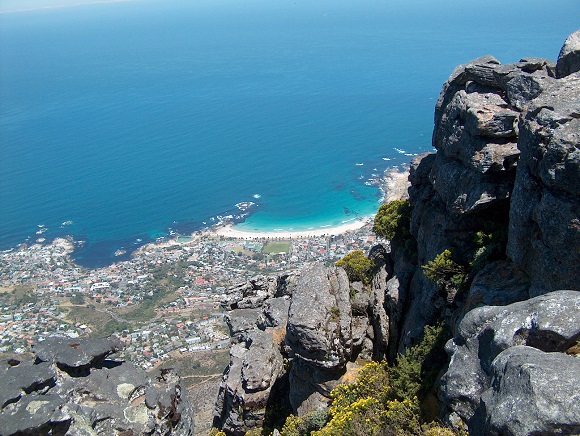
The top of Table Mountain offers stunning views of Cape Town and surrounds, so it is no surprise that this is a very popular attraction.
Most visitors take the cableway to the top. The cableway closes when there are adverse weather conditions such as strong winds or when a “tablecloth” of cloud blankets the top of the mountain. It is therefore recommended that you head up at the first favourable opportunity. You can check on the cableway website for current conditions before setting off. The lower cableway station is at Tafelberg Road.
The cableway also closes for annual maintenance: in 2023 – the last week in July and first week in August.
The easiest hike to the top is via Platteklip Gorge. “Easy” is a relative term and the hike involves an elevation gain of about 680 m (2231 ft). An option is to take the cable car down.
Table Mountain’s highest point (about 1086 m (3563 ft)) is marked by Maclear’s beacon.
“Table Mountain National Park (TMNP) stretches 70km from Signal Hill and Table Mountain in the north to Cape Point in the south and includes a Marine Protected Area and many of the beaches around the Peninsula.” [1]
Robben Island
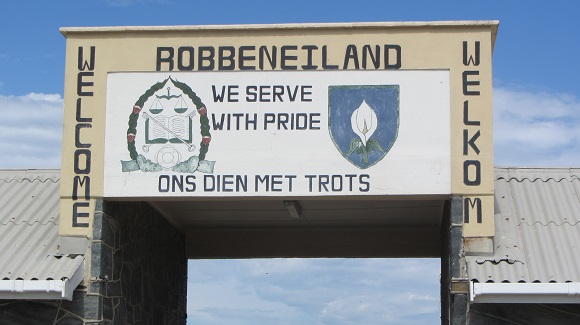
Robben Island has a long history but is best known for its maximum-security prison that housed apartheid-era political prisoners (amongst others). The most famous prisoner was Nelson Mandela who spent the first 18 years of his imprisonment here from 1964 to 1982.
The island lies off Cape Town’s Table Bay and the ferry leaves from the Nelson Mandela Gateway at the V&A Waterfront. You need to set aside about half a day for the tour. It is recommended to book online in advance.
I tend to be prone to seasickness so found the following website useful to check forecast wave and wind conditions: https://www.windfinder.com/forecast/table_bay
The standard tour takes place in two phases:
- A walking tour of the maximum-security prison. Most of the guides are ex-political prisoners. This phase of the tour ends at the prison block that housed the senior political prisoners and you will see Nelson Mandela’s cell as it was in 1964 before more furniture was added.
- A bus tour to view the other sites on the island such as the limestone quarry.
The tour does not visit the Robben Island penguin colony.
As per the UNESCO World Heritage Site entry: “Robben Island and its prison buildings symbolize the triumph of the human spirit, of freedom and of democracy over oppression”.[2]
Boulders Penguin Colony
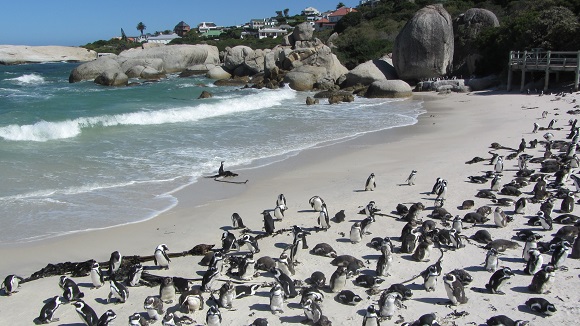
The endangered African penguin is endemic to southern Africa, where it breeds at about 28 locations along the coast of South Africa and Namibia. The Boulders penguin colony of Simon’s Town is one of few that is mainland based.
(Another easily accessible mainland-based penguin colony is at Stony Point Nature Reserve in Betty’s Bay – about a 1.5-hour drive from the V&A Waterfront.)
The Boulders penguin colony is protected, and their home beach areas form part of Table Mountain National Park (Boulders section).
Somewhat confusingly, the best and main viewing area to see the penguins is Foxy Beach. Park at the Seaforth Square parking area and then head to the visitor centre to buy tickets. There are two viewing platforms that are accessed via boardwalks.
If you would like to try and swim with the penguins, then walk about 500 m to Boulders Beach along Willis Walk or drive and park at the Boulders Beach parking area. Your entrance ticket for Foxy Beach is also valid for Boulders Beach. Boulders Beach is small, so it is better to visit when it is not high tide.
The penguins are cute, but they are wild, and we are not allowed to touch them or even get too close to them as this may stress them.
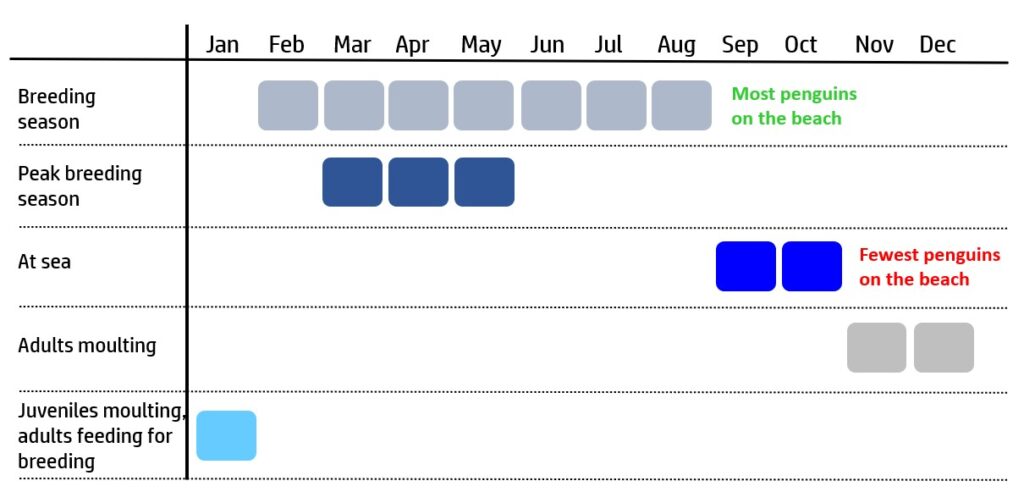
What is the best time of year to see the Boulders penguins?
African penguin seasons vary regionally. The calendar below applies to the penguins in the south-western parts of the range (this includes the Boulders penguins).
What is the best time of day to see the Boulders penguins?
There are penguins on the beach at any time of day. Some of the penguins leave in the early morning to forage and then return in the late afternoon. This is particularly true in breeding season when parents generally return in the late afternoon to feed their chicks.
Wine farms
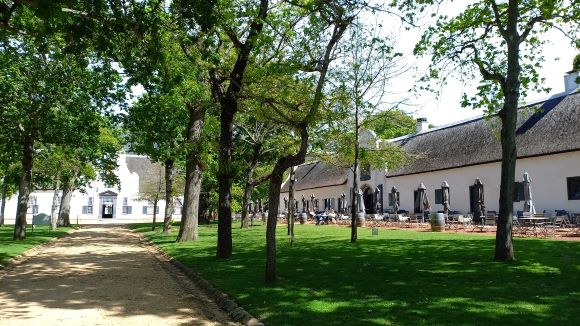
Cape Town has its own wine route – the Constantia Wine Route. There are several wine farms, ranging from historical to modern, that are only a 30-minute drive from the V&A Waterfront.
Lovely Groot Constantia is the oldest wine farm in South Africa, established in 1685. It is thought that the manor house was built soon thereafter. The house was badly damaged by fire in 1925 but was restored and is now a museum.
For more information on visiting the Cape Winelands, please see:
https://thetravelinfoblogger.com/visiting-the-cape-winelands-of-south-africa/
Signal Hill and Lion’s Head
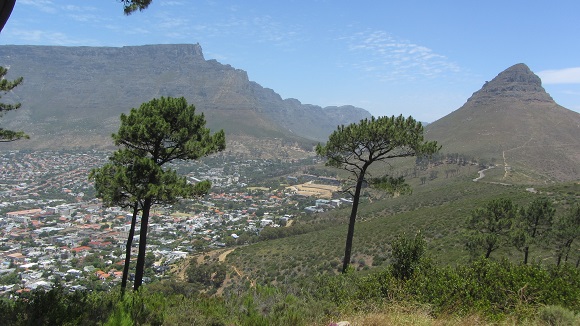
A short drive up Signal Hill leads to a parking area with great views of the Cape Town city centre, Table Mountain and the Atlantic Ocean.
This is also a paragliding launch spot.
The Noon Gun is a pair of historical cannons, one of which is fired at noon every day (except Sundays and public holidays). These are not on top of Signal Hill but rather at Lion Battery on the lower slopes.
The only way to summit adjacent Lion’s Head is to hike up. This is a very popular hike especially for sunrise and sunset views and even on full moon nights.
Chapman’s Peak Drive
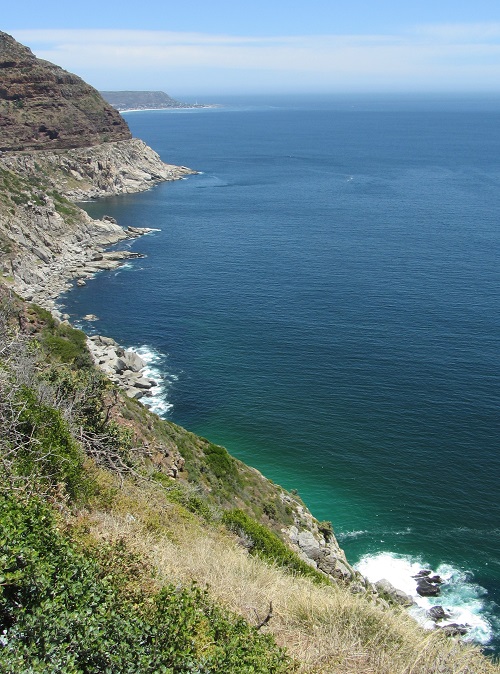
Chapman’s Peak Drive is built into the steep rocky slopes along the Atlantic Ocean between Hout Bay and Noordhoek. It is only about 9 km long but is one of the most beautiful coastal drives in the world.
There are a handful of viewing points along the route where you can stop to admire the scenery.
Please note that toll fees are payable.
Beaches
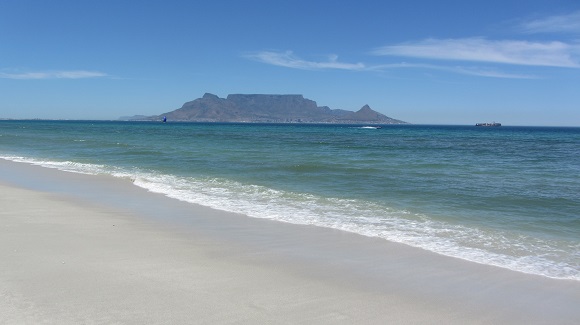
The seawater around Cape Town is cold, colder and icy so you usually won’t see large numbers of people in the water. The beaches are very popular though.
South Africa is known for having a high incidence of shark attacks in a world context. To put this into perspective however, as per the International Shark Attack File, there have been 58 unprovoked shark attacks along the whole Western Cape coast (not just Cape Town) between 1905 and 2021. False Bay in particular is known for its sharks, but in recent years, the Shark Spotters organization has contributed greatly to peace of mind.
These are some of Cape Town’s best-known beaches:
Clifton beaches
Clifton is the place to see and be seen. There are four gorgeous wind-sheltered beaches which are accessed by steps from the road above. The traffic and parking in this area is usually a nightmare during peak season and weekends. Some of the most expensive properties in South Africa are located in Clifton.
Camps Bay
Camps Bay is similarly popular and trendy. There are many restaurants, cafes and bars across the road from the beach. The Twelve Apostles (part of the “Back Table”) overlooks Camps Bay.
Muizenberg
Muizenberg is a long family-oriented beach on False Bay. It has good conditions for beginner surfers. This is where you will find the long row of multi-coloured beach huts that are so popular with photographers.
St James Beach
St James Beach on False Bay is ideal for families with young children as there are rock pools to splash around in as well as a tidal pool. This small beach also has some multi-coloured beach huts.
Bloubergstrand
Bloubergstrand is a long beach about a 20 km drive north of the V&A Waterfront on Table Bay. This beach is the place to come for the iconic views of Table Mountain as seen above. The beach is popular with kite surfers and windsurfers.
Seaside suburbs of Cape Town
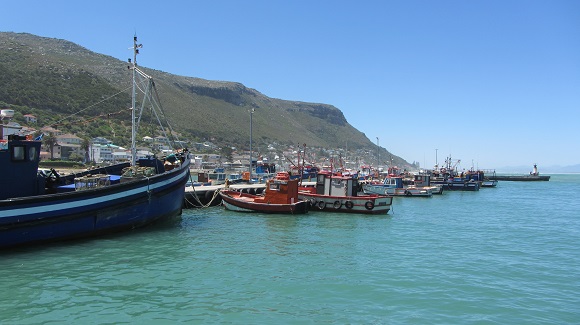
You can spend an enjoyable day or two exploring some of the seaside suburbs of Cape Town. The suburbs vary widely, from unpretentious to sophisticated and vibrant to peaceful. There are many well-known restaurants associated with the various suburbs.
Atlantic Seaboard
The suburbs of the Atlantic Seaboard are on the western coastline of Cape Town, south of the V&A Waterfront: Green Point, Sea Point, Clifton, Camps Bay, Bakoven, Llandudno and Hout Bay.
Hout Bay has a fishing harbour, boat trips to the Duiker Island Cape fur seal colony and weekend markets.
False Bay coast
There are several characterful suburbs along the False Bay coast: Muizenberg, St James, Kalk Bay, Fish Hoek and Simon’s Town.
Simon’s Town is home to a naval base and the statue of Just Nuisance (a great dane who was enlisted in the Royal Navy). Many ocean-based adventure activities take place from Simon’s Town.
Kalk Bay has a fishing harbour which is frequented by some seals.
Bo-Kaap
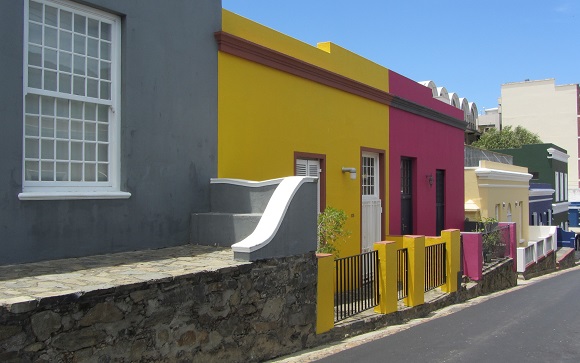
Bo-Kaap is a neighbourhood situated between the Cape Town city centre and Signal Hill. It is known mainly for its picturesque colourful houses and Cape Malay culture.
If you just want to take some photos, then you can park in one of the streets and explore. Other options include walking tours, food tours and cooking tours, many of which are conducted by members of the community. There is a small museum in Wale Street.
There are several myths about the history of Bo-Kaap. Rebecca Davis and Haji Mohamed Dawjee investigated to get to the bottom of some of these:
“When De Waal built the first houses for rent in the Bo-Kaap in the 1780s, they were initially occupied by both white immigrants who worked in town and by the Mardijkers – free Muslims brought to the Cape for their skills, who were never enslaved.” [3]
“When slaves in Cape Town were emancipated by the British in 1834, many of them moved above Buitengracht Street to join this growing community. Many were Muslim – but by the late nineteenth century, Bo-Kaap was vibrant and diverse; home to musicians, tailors, labourers, and the artisans who effectively built Cape Town.” [3]
“From 1957 onwards, forced removals did take place from Bo-Kaap – of everyone who was not designated a ‘Malay’, the apartheid classification for Cape Muslims. The Group Areas Act made the Bo-Kaap a Muslim-only area for the first time in its history.” [3]
“In fact, nobody seems quite sure when exactly the Bo-Kaap’s bright colours appeared, and what exactly triggered the custom, but it’s pretty certain that this was a development relatively late in the 20th century.” [3]
Castle of Good Hope
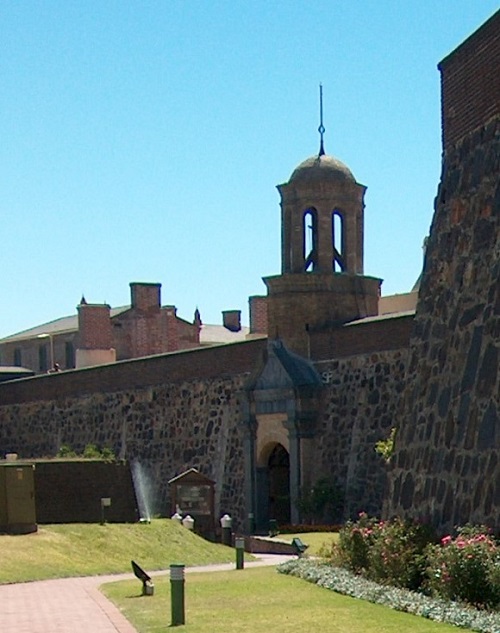
The Castle of Good Hope, also known as “The Castle”, is more accurately a fort, and has five bastions. It was built between 1666 and 1679 by the Dutch East India Company to replace an older fort made of clay and timber. The Castle of Good Hope is the oldest remaining colonial building in South Africa.
There are regular guided tours, and a visit can be fun for children. For information re tour times, please see: https://www.castleofgoodhope.co.za/index.php/events
Cape Floral Kingdom / Cape Floristic Region
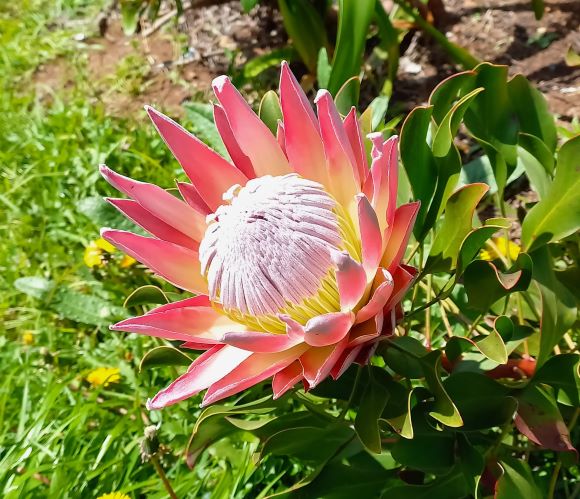
The Cape Floral Region Protected Areas is a UNESCO World Heritage List property as: “It is one of the world’s great centres of terrestrial biodiversity.” [5]
There is no one specific place to visit but you will notice this special plant life as you explore the national parks, nature reserves and wilderness areas in the south-western parts of South Africa.
The Cape Floristic Region (CFR) is noteworthy for several reasons:
- It is the smallest of the world’s six floral kingdoms.
- It is the only one that is found completely in one country.
- It has high diversity / number of species (about 8700).
- An impressive 70% of species are endemic i.e., found nowhere else in the world.
The fynbos biome contributes about 80% of the Cape Floral Kingdom species and includes the much-loved proteas. For many, the Cape Floral Kingdom and fynbos are essentially one and the same.
South Africa’s national flower is the king protea.
Kirstenbosch National Botanical Garden
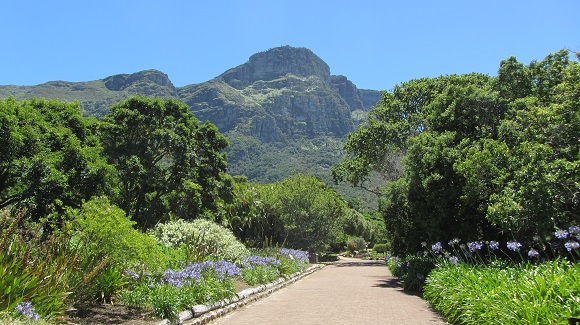
Lovely Kirstenbosch National Botanical Garden is situated on the lower eastern slopes of Table Mountain. The focus is on plants indigenous to South Africa.
It was established in 1913, and the cultivated portion is 36 hectares in extent. The rest of the estate is a protected area supporting fynbos and natural forest.
“There are always flowers and interesting plants to be seen at Kirstenbosch and every season has its charm, however, to see the fynbos at its best and the maximum number of plants in flower, the best time to visit is towards the end of winter, in spring or in early summer (August-November).” [4]
“The Boomslang” (tree snake), or more accurately the Centenary Tree Canopy Walkway, is a 130 m (427 ft) long raised walkway that snakes its way over and through the trees of the Arboretum.
Kirstenbosch hosts long-term and short-term outdoor sculptural art exhibitions as well as indoor exhibitions. It is also the venue for the popular Summer Sunset Concerts and Carols at Kirstenbosch.
Check the website for info re free guided tours: https://www.sanbi.org/gardens/kirstenboch/visitor-information/guided-tours/
Cape Point
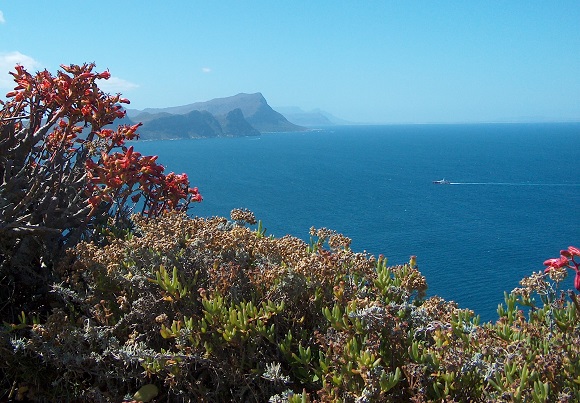
Cape Point and Cape of Good Hope generally refer to the nature reserve in the southernmost part of the Cape Peninsula, which forms part of the Table Mountain National Park.
It is a slow +- 55 km drive (depending on the route taken) from the V&A Waterfront to the entrance gate.
A typical tourist visit involves a drive through the nature reserve to the Cape Point car park. It is then a quick to-be-paid-for funicular ride (or a walk) up to the base of the old lighthouse. From there you walk along the pathways for wonderful views from the clifftops.
The baboons at Cape Point are known to be rather bad mannered! Please take note of the Table Mountain National Park guidelines re baboons. This post provides more information about how to behave around baboons: https://thetravelinfoblogger.com/encountering-baboons-in-the-wild/
The Cape of Good Hope is the most south-westerly point of the African continent. This is not to be confused with Cape Agulhas (much further along the coast to the south-east) which is the southernmost point of the African continent and is also where the Atlantic and Indian Oceans officially meet.
If you have more time, there are walking and hiking trails to explore, secluded beaches, tidal pools and shipwrecks. Nature enthusiasts can engage in bird watching, low-key game viewing and even whale spotting (binoculars needed) (generally between June and November).
Shark cage diving
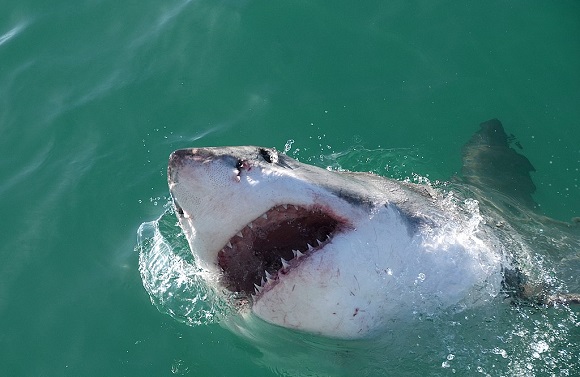
The main sites for shark cage diving in South Africa are Simon’s Town (False Bay), Gansbaai (165 km from V&A Waterfront), Mossel Bay and Durban.
There are operators that operate from more than one site, so it may be a good idea to look at their websites or contact them for an opinion on the best location for the time of year that you are visiting and your schedule. The South African winter months are generally the best time for shark spotting in the Cape.
Gansbaai was known as the “great white shark capital of the world” but there was a sudden decrease in numbers from around 2017. There are different theories as to why this has happened, and the most likely seems to be orca predation. Shark cage diving continues nevertheless as there are other shark species to see. The good news is that there have been many sightings of great white sharks again in the winter of 2022.
Shark cage diving is a controversial activity as many operators use chum or other baiting methods to attract sharks. Some believe that this practice may change shark behaviour around humans and boats and at the very least is a staged wildlife experience. There are however different types of baiting so you will need to decide what is acceptable to you.
Whale watching
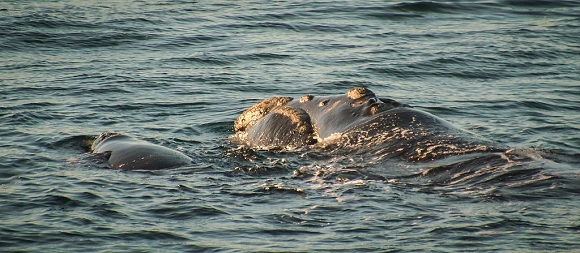
Whale-watching season in the Cape Town area is roughly between June and November. Land-based watching (binoculars are recommended) is possible from many elevated vantage points.
Boat-based whale watching mainly takes place in False Bay.
Southern right whales are the whales most commonly seen in Cape waters. In winter, they migrate from the southern oceans to the sheltered bays of South Africa to calve, socialize and mate.
There is a group (breeding stock) of humpback whales that migrate in winter to the warmer waters of south-eastern Africa, Madagascar, etc to breed. They visit the Cape waters on their way.
Both humpback whales and southern right whales are not shy – they seem to enjoy breaching, tail slapping and flipper slapping and are curious about boats.
Bryde’s whales are resident in these waters all year but do not show themselves often.
Dolphin watching is popular all year round.
If you have more time, Hermanus (about 125 km from the V&A Waterfront) is known to be one of the best whale-watching locations in the world.
Cape Town Minstrel Street Parade / Cape Town Minstrel Carnival / Kaapse Klopse / Tweede Nuwe Jaar
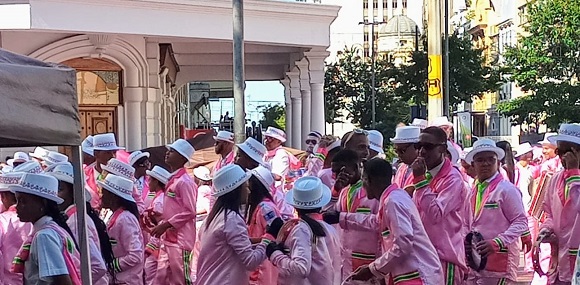
The minstrels march and dance through the streets of Cape Town in a fun-filled riot of colour and music. The Kaapse Klopse is part of Cape Town’s heritage, and a unique musical tradition has evolved.
The parade usually takes place on the 2nd of January. The date and term Tweede Nuwe Jaar (Second New Year), originate from the days of slavery when slaves were only given one day off work every year. They used the day to celebrate.
The thousands of minstrels belong to competing troupes. According to the Kaapse Klopse Karnival Association, the first troupe dates back to around 1873.
Traditionally the performers march through the streets of District Six, Bo-Kaap and the Grand Parade. The routes are published every year.
In recent times, the parade has been impacted by disagreements between rival organizing associations over control and funding.
Please note that the Cape Town Carnival is a different event.
Other attractions
Other well-known tourist attractions in Cape Town are: Houses of Parliament, Company’s Garden, District Six Museum, The Old Biscuit Mill, etc.
References:
- https://www.sanparks.org/assets/docs/parks_table_mountain/tmnp-visitors-map.pdf – retrieved 202204
- https://whc.unesco.org/en/list/916/ – retrieved 202204
- https://ewn.co.za/2019/09/20/bo-kaap-s-complicated-history-and-its-many-myths – retrieved 202204
- https://www.sanbi.org/gardens/kirstenboch/garden-information/seasons/ – retrieved 202204
- https://whc.unesco.org/en/list/1007/ – retrieved 202206
You may also like:
Visiting the Cape Winelands of South Africa