

Last Updated on: 15th October 2025, 10:12 pm
Lightning is an extremely complex phenomenon. This post will keep it simple, but for lightning safety guidance to make sense, it is necessary to understand the six lightning injury mechanisms.
Lightning Injury Mechanisms
Contrary to popular belief, it is not direct strikes that injure or kill most people.

Direct strike (3-5%)

A direct strike occurs when the lightning directly strikes the person / object.
Contact Injury (3-5%)

Contact injury occurs when a person touches or holds onto an object, which is struck and some of the current then flows through the person.
Side Flash / Splash (30-35%)
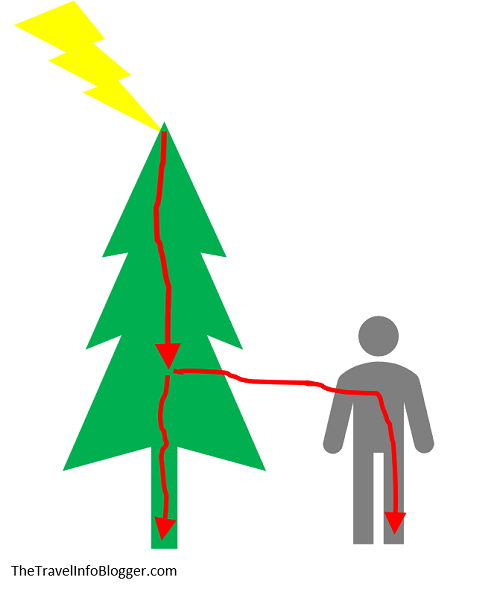
Side flashes occur when lightning that has hit an object, for example a tree, travels down that object before a portion jumps to a nearby person.
Side flash may also take place from person to person.
Ground Current / Earth Potential Rise / Step Potential (50-55%)

Ground current occurs after each strike as current travels through the surface of the earth. Voltages are set up in the ground, decreasing away from the strike point. If someone is close to the strike point, a voltage difference may arise between the feet, and current will flow through the legs into the lower part of the body. For four-legged animals, the damage can be worse if the current flows between front and back legs and the heart is impacted.

Another aspect of the ground current category is the incidence of surface arcs. As ground is not homogeneous, it allows for arc generation points. Also, irregularities occur on mountainsides and spreading lightning current may reach the surface and discharge as a high energy surface arc.
Upward Streamer (10-15%)
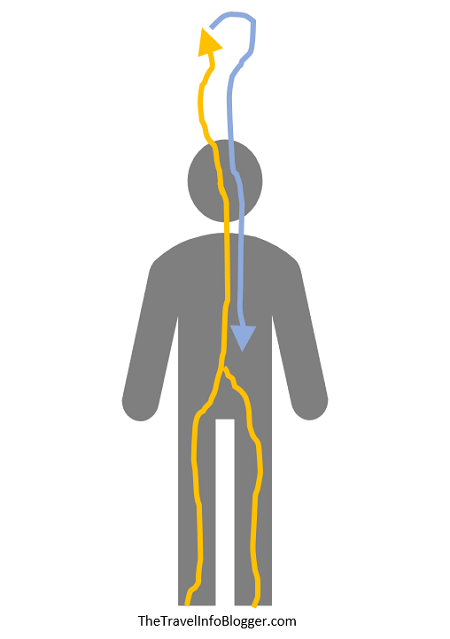
As lightning approaches earth (as a downward stepped leader), multiple upward streamers are induced in objects below the thunderstorm. If a person is the pathway for an upward streamer, and a direct strike does not occur, then the significant upward streamer current and collapsing current can cause injury or death.
Barotrauma and Blunt Injury (Unknown)

These injuries occur as a result of the explosive force of the lightning shock wave as well as other factors.
Lightning Risk Management for Hikers
Experts agree on the following:
There is no place outdoors that is safe when a thunderstorm is in the area, so if at all possible, get to:
1) a large fully enclosed and substantially constructed building with properly earthed plumbing and wiring
2) a fully enclosed, solid, metal-topped vehicle, such as a car or bus.
Of course, in the hiking context, this is often not possible.
Proactive measures for hikers
1) Understand the lightning profile of the area you are visiting. There are areas that have high lightning strike density versus that don’t (this applies on a macro and micro level)
2) Check the weather forecast and reconsider the timing of your hike if thunderstorms are forecast.
Reactive measures for hikers
For certain risk management aspects, there is no absolute certainty, so we need to rely on the best-effort advice of those who understand both lightning and hiking.
Please see the excellent diagram below from NOLS in the USA:

| ACTION | REASON |
|---|---|
| Do get off high peaks, ridges and significantly higher ground | Lightning tends to strike high points and the terrain around it |
| Do avoid wide open spaces; don’t be the highest object in an area | Lightning tends to strike taller objects in an area |
| Do avoid isolated trees, poles, towers, etc | Lightning tends to strike taller objects in an area |
| If you have no other choice: Do shelter in a ravine or depression Do shelter under a group of shorter trees among larger trees in a forest Do shelter in a deep cave | |
| Don’t shelter inside a shallow cave, cave entrance, under a small cliff or rock shelter or outcrop | High energy surface arcs may travel through you |
| Tents do not protect you from lightning | |
| Small open structures such as rain shelters, pavilions, picnic shelters, porches and lean-tos do not protect you from lightning | Side flash and ground current may come into play |
| A fully enclosed building does not protect you from lightning if it is ungrounded and made from non-conducting material | |
| Don’t touch conductors eg wire fences, metal ladders, wet extended ropes | These objects can carry significant lightning current even if they are some distance from the lightning strike point |
| Don’t lie down on the ground | Reduce exposure to ground current |
| Don’t stand in water or near a large body of water | Water is a good conductor of electricity |
| If in a group, do spread out | To try and avoid multiple casualties and increase the chance that someone can provide assistance if a person is struck |
| Do assume the “lightning position” – keep feet together, minimize contact with the ground, keep low (Note: experts warn that it is much more important to first get to a safer area) | The most important aspect of this position is to keep your feet together (only have one point of contact with the ground) – reduce the chance of step potential. Keep your contact with the ground as small as possible – minimize exposure to ground current. Keep low – may slightly reduce effects of side flash and upward streamers |
First Aid for Lightning Victims
Key points for saving lives:
1) It is safe to touch someone who has been struck by lightning as victims do not carry residual electrical charge
2) The primary cause of death is cardiac and respiratory arrest at the time of the injury
3) Perform cardio-pulmonary resuscitation if necessary.
Further reading / viewing recommendations
- National Lightning Safety Council
- The National Weather Service in the USA website provides useful lightning safety information
- For non-hiking- specific lightning safety guidelines, refer to the Lightning Brochure from the National Weather Service in the USA
- The TV documentary series: Lightning Pathologist.
References:
- Davis, Chris & Engeln, Anna & Johnson, Eric & McIntosh, Scott & Zafren, Ken & Islas, Arthur & McStay, Christopher & Smith, William ‘Will & Cushing, Tracy. (2012). Wilderness Medical Society Practice Guidelines for the Prevention and Treatment of Lightning Injuries: 2014 Update. Wilderness & environmental medicine. 23. 260-9. 10.1016/j.wem.2012.05.016.
- Cooper, M.A., & Holle, R.L. (2010). Mechanisms of lightning injury should affect lightning safety messages. Preprints, International Lightning Meteorology Conference, Orlando, FL.
- Gookin, J. (2010). Backcountry Lightning Risk Management. 21st International Lightning Detection Conference.
- Cooper, Mary Ann & Andrews, Christopher & Holle, Ronald & Blumenthal, Ryan & Navarrete Aldana, Norberto. (2016). Lightning injuries. Chapter 5: Lightning-related Injuries and Safety. Auerbach’s Wilderness Medicine, Seventh Edition (2017)
- Roeder, WP. Analysis of short notice outdoor lightning risk reduction and comments why it should not be taught.
- https://nols.edu/media/filer_public/98/ab/98abb1d8-47c7-45fb-bc0a-e8e1dd8d1840/risk-management-lightning-for-backcountry-campers.pdf retrieved 20210118
- https://www.weather.gov/media/safety/Lightning-Brochure18.pdf retrieved 20210118
2 replies on “Lightning Safety for Hikers”
To whom it may concern: The reason for this email is to ask you to email me the above information so that I can use it whenever I or we experience these lightning situations.
Hi Vusumuzi, I am pleased that you found this info to be useful. I have emailed you.