
Last Updated on: 17th February 2025, 07:23 pm
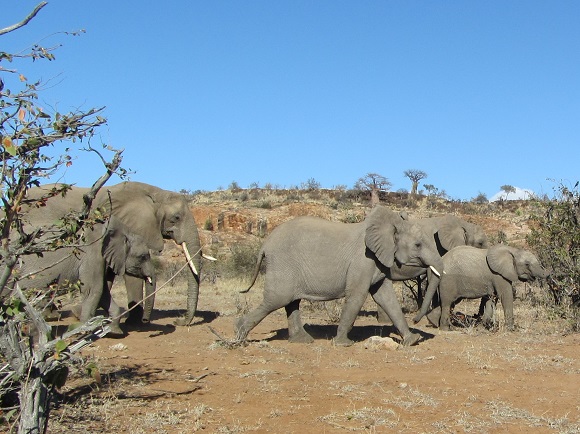
Mapungubwe National Park is one of South Africa’s best kept secrets. It is located in the far north of South Africa bordering Botswana and Zimbabwe where the Shashe and Limpopo rivers meet. There are wonderful rocky landscapes with scattered baobab trees as well as sections of riverine forest. Not only is Mapungubwe a game reserve, but it is also home to archaeological sites of a society that inhabited the area over seven centuries ago.
Top reasons to visit Mapungubwe National Park
Confluence Viewpoint
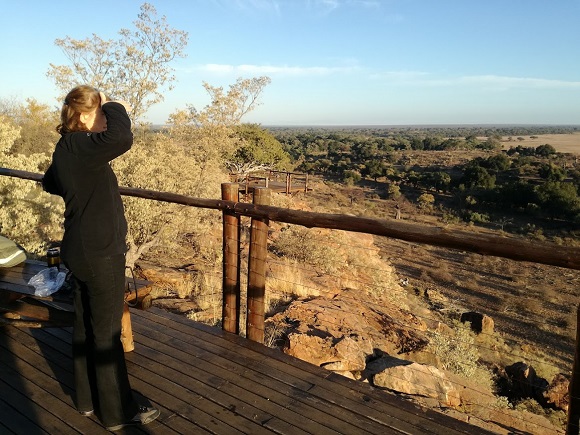
For me, there has always been something romantic about being able to look out over more than one country at a time, especially in a natural setting. SANParks has built an excellent facility consisting of several viewing platforms at the top of a hill overlooking the confluence of the Limpopo and Shashe rivers. This is where South Africa, Botswana and Zimbabwe meet (an international tripoint). Sunrise views, sunset views, anytime views – all are special.
Don’t be surprised if you hear bells in the distance. Herders sometimes bring their cattle into the park to graze and then return across the border in the evening. According to an undated SANParks letter, SANParks is trying to address this situation in an amicable manner.
Treetop Walk

The Treetop Boardwalk is a long raised wooden walkway which overlooks the Limpopo River. It is a great place to spend time birdwatching or looking down on wildlife in the riverbed area. It is a short drive from Leokwe Camp.
Please note: The Treetop Boardwalk was closed in September 2022 as it has been damaged by flooding and other “natural forces”. Since then, visitors have reported that a short section of the Boardwalk is still usable. Planning is underway to create something similar in a different location.
Mapungubwe Hill
The Mapungubwe Cultural Landscape is registered as a World Heritage Site. According to the UNESCO World Heritage Site list entry: “The Mapungubwe Cultural Landscape demonstrates the rise and fall of the first indigenous kingdom in Southern Africa between 900 and 1,300 AD.” [1]
The historical site of most interest to visitors would be Mapungubwe Hill and surrounds.
“In 1932 the student Jerry van Graan discovered the treasures of Mapungubwe. . . . As soon as they reached the top of Mapungubwe they found many golden objects: bangles, beads, nails and a miniature buffalo. Further away they found a rhino, a skeleton and gold anklets. In total they found about 2,2 kilograms of gold and many other clay and glass artifacts.” [2]
Jerry alerted the University of Pretoria and from 1933 onwards, after rights were obtained, the university conducted archaeological excavations and research.
The Kingdom of Mapungubwe participated in trade and was prosperous. The UNESCO entry explains: “From its hinterland it harvested gold and ivory – commodities in scarce supply elsewhere – and this brought it great wealth as displayed through imports such as Chinese porcelain and Persian glass beads.” [1]
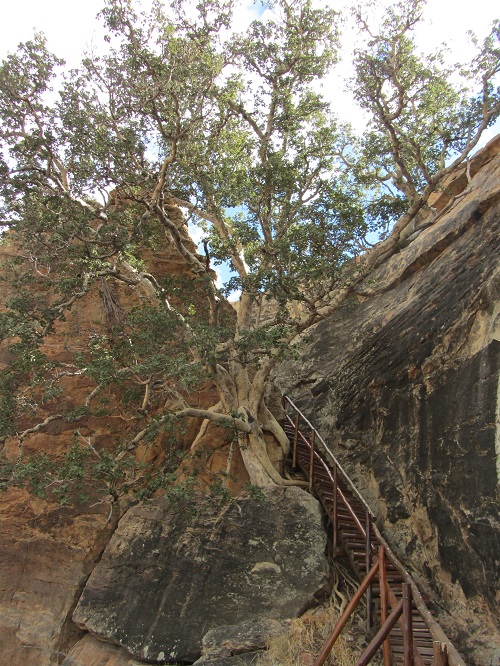
Taking a heritage tour is the only way to visit Mapungubwe Hill. Check at the main gate reception desk when tours can be booked. The tour starts at the main gate and you are driven in a game viewing vehicle by a guide down an access-restricted road. We parked and walked a short distance to the hill. The top of the hill is easily reached via a wooden stairway. Our guide was most informative, and the tour is not to be missed.
There are 150 rock art sites in Mapungubwe from when the San inhabited the area. At time of writing, there are no tours available to visit the rock art sites.
The Mapungubwe Interpretation Centre
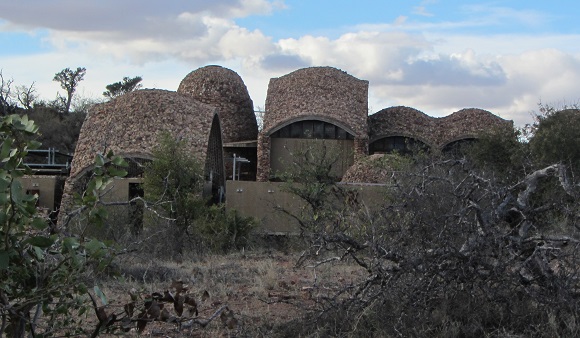
The Interpretation Centre building is worth seeing in its own right: it won the award for World Building of the Year 2009 at the World Architecture Festival. Please note that my photo does not do the building justice.
The architect provides the following background: “The complex rocky landscape was both the inspiration for the design and the source of the materials for the construction of the new Interpretation Centre, resulting in a composition of structures that are authentically rooted to their location.” [3]
It is however the contents that is the main reason to visit.
The Mapungubwe Collection is curated by the University of Pretoria and a significant part of the collection which is national heritage is on display at the Mapungubwe Interpretation Centre. It is well-presented and showcases ceramics, clay figurines, metal, gold, bone, beads and other cultural artefacts in context of the history.
The exhibition of the National Treasures Mapungubwe Gold Collection can be viewed in the new Javett-UP Arts Centre and other parts of the collection at the University of Pretoria Museums.
“Voortrekker Monument” Hill
It has been suggested that a hill in Mapungubwe was the inspiration behind architect Gerard Moerdyk’s design of the Voortrekker Monument in Pretoria. I have read several theories re the inspiration for the design, but none of them mention the hill. It is a fun story though and the resemblance is clear. The specific hill (a butte I assume) can be seen from a road in the central eastern part of the park. It can also be seen from a lookout point near the Interpretation Centre.
Accommodation in Mapungubwe National Park
It is important to note that Mapungubwe National Park has eastern and western sections which are separated by private land. To get from one section to the next, you need to leave the park and then re-enter. The Treetop Walk, Confluence Viewpoint, Interpretation Centre and Mapungubwe Hill are all in the eastern section of the park.
Camps in the eastern section
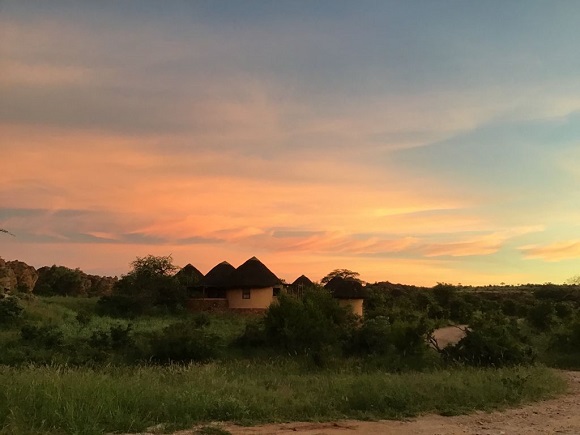
Leokwe Camp is the main camp of the park and we stayed in a family cottage. It was a bonus to be able to view game from the comfort of the large patio. There is a small swimming pool and I have been told that elephants sometimes visit for a drink of water. The camp is unfenced.
Note that the cottage showers are outdoor showers which are perfect for a warm day, but a rather chilly challenge for a winter morning or evening.
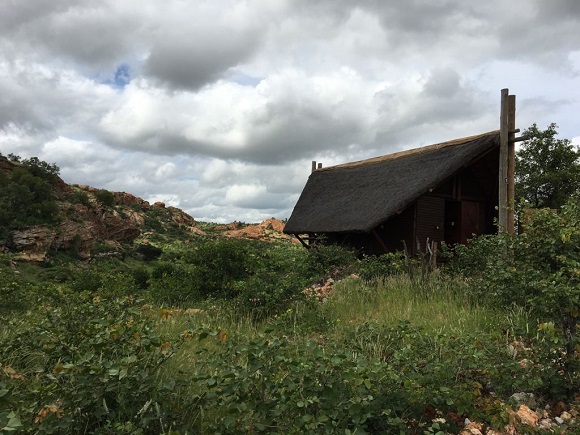
The other camp in the eastern section is the Vhembe Wilderness Camp. There are 4 cabins, each with a bathroom, and there is a communal kitchen area. The camp is unfenced.
The SANParks site states that the camp can only be accessed by 4×4 or high-clearance vehicle, but a friend of mine says that a standard vehicle would be fine as long as you drive slowly.
Camps in the western section
Limpopo Forest Tented Camp
Tshugulu Lodge
Mazhou Camping Site
References:
- https://whc.unesco.org/en/list/1099/ retrieved 20201103
- https://www.sanparks.org/parks/mapungubwe/tourism/progress.php retrieved 20201103
- https://www.peterricharchitects.com/mapungubwe-interpretation-centre retrieved 20201103
Encountering baboons in the wild