
Last Updated on: 17th February 2025, 07:35 pm
Jakhu Temple
Shimla, in the foothills of the Himalayas, is the capital of India’s Himachal Pradesh state.
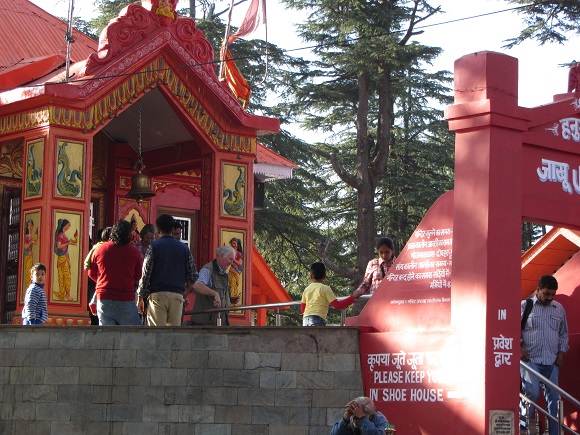
The Jakhu Temple, also spelled Jakhoo, is located on Shimla’s Jakhu Hill. The temple honours Hanuman, the Hindu monkey god. According to tradition, Hanuman rested here briefly while searching for a special plant required to revive Rama’s seriously wounded brother Lakshmana. In the process, the hilltop was flattened because of his weight. It is not clear exactly when the temple was built but is said to be ancient. The temple protects the footprints of Hanuman.
Statue of Hanuman
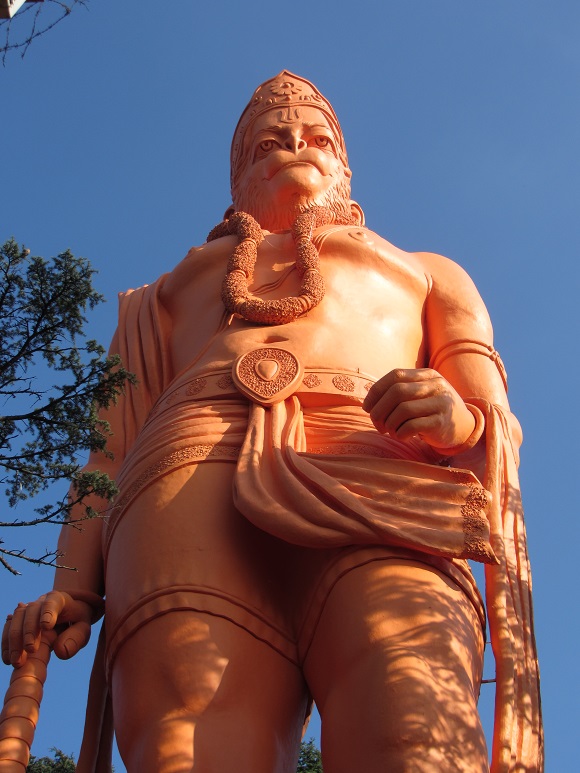
A huge 33 m (108 ft) statue of Hanuman is on the site and was unveiled in 2010. This statue is one of the tallest Hanuman statues in the world. Jakhu Hill, at 2,455 m (8,054 ft), is the highest point in Shimla and the statue overlooks Shimla and can conversely be seen from several points in Shimla.
How to get there
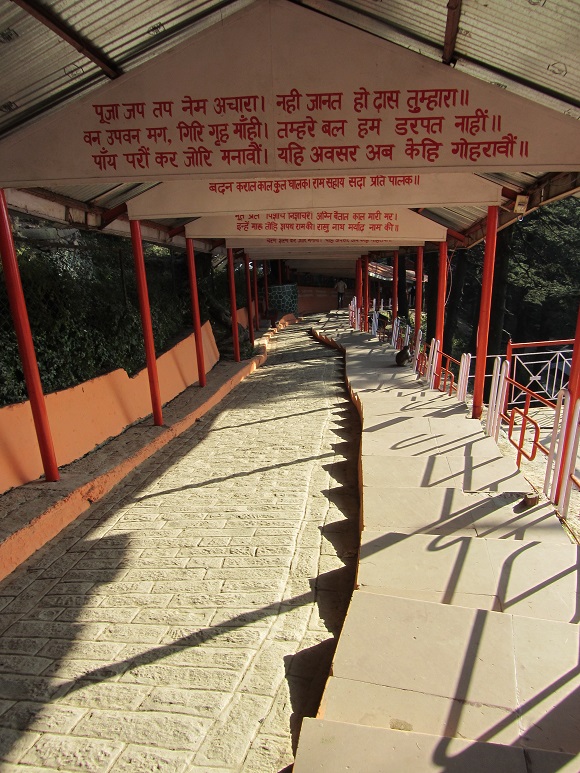
When we were in Shimla, we hired a taxi and were driven around the hill and then further up a narrow road on the southern side. From the drop off point, it is a short walk up a covered walkway with shallow steps or a paved gentle slope to the top of the hill.
If you have the time and are feeling energetic, there is a steep footpath that allows you to rather walk up the hill. The change in elevation is about 200 m (656 ft) from the base. For many, the walk up the hill is an intrinsic part of the experience.
Jakhu Ropeway, which operates cable cars from south-east of The Ridge, seems like a good option.
Be prepared for the monkeys
There is a high concentration of monkeys on the hill as there is a ready supply of food: monkeys are often fed temple-blessed food offerings by devotees in honour of Hanuman.
As Hanuman is the Hindu monkey god, it is fitting that the site is home to monkeys.
The monkeys are however not viewed in a positive light by all. They are considered a menace by many as they are not afraid of humans and frequently snatch items from visitors: food, glasses, sunglasses, caps, dupattas, phones, etc. They also rifle through the pockets of tourists. Sometimes monkeys wait for a food bribe in order to return an item, which obviously only reinforces the behaviour. Sometimes the item is broken or damaged in the snatching process and sometimes the item is not retrievable.
I had read about the badly behaved monkeys before we visited, so I left my glasses, sunglasses and hat at the hotel. Fortunately, I can see well enough without my specs. I had my camera and phone in my bag which was strapped across my body and held in front. At the drop off point, vendors hired out sticks with which to chase away the monkeys. I was surprised and relieved that this is considered to be acceptable behaviour and we promptly hired sticks.
As it turned out, we were not harassed by the monkeys at all and enjoyed our time in this lovely setting.
The monkeys are in town too
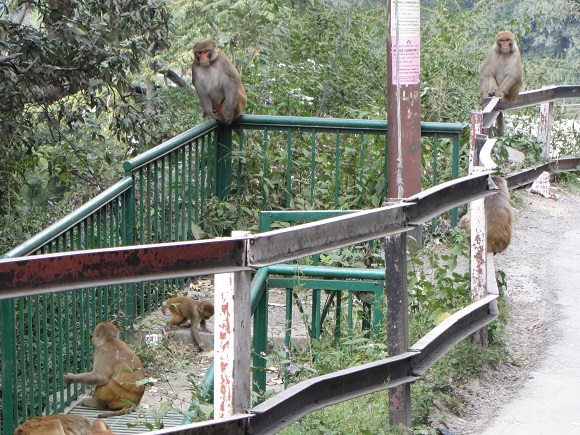
Monkeys are not only to be found on Jakhu Hill; there are also those that roam around town and the surrounding areas. The species of monkeys in the Shimla area is the rhesus macaque.
Even more concerning than the snatching escapades, is the incidence of monkey bites.
According to a letter to the editor of the Journal of Global Infectious Diseases[1], between 2014 and 2019, on average 1326 people were treated by hospitals in Shimla for monkey bites each year. This works out to 3.6 bites a day. These numbers would be for incidents occurring in the greater Shimla area.
When we visited, I was only aware that we needed to be vigilant on the hill. We thus walked around town without sticks (and with sunglasses) and we did not feel threatened at any time. So, it seems to be situation dependant as to whether the monkeys bother you or not.
References:
- Thakur S, Chauhan V, Sharma K, Singh M. “Over 8000 macaque bites since 2014 but no herpes B virus infection reported from Shimla, India.” Journal of Global Infectious Diseases 2020;12:163-4. https://pmc.ncbi.nlm.nih.gov/articles/PMC7733425/
You may also like:
Incredible India travel itinerary 11 days
One reply on “Jakhu Temple in Shimla India and the Monkeys”
[…] Jakhu temple in Shimla India and the monkeys […]